In Central London’s vibrant medical district, patients increasingly prioritise holistic health, seeking treatments that harmonise with the body’s natural physiology. From tailored nutrition to low-toxin living, health-conscious individuals across Marylebone and the West End expect their healthcare solutions to be both effective and bio-harmonious. Restorative dentistry is no exception.
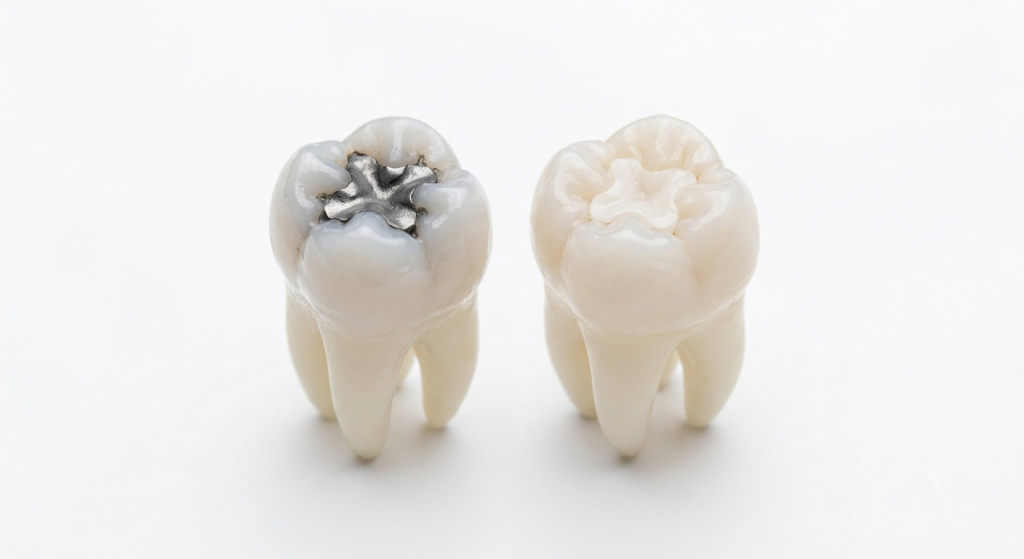
Historically, dental repair relied heavily on dental amalgam, a mixture containing elemental mercury, silver, tin, and copper. While amalgam served dentistry for over a century, advances in dental material science have ushered in a new era. Today, mercury-free dental care utilises highly biocompatible materials such as ceramic restorations and composite resins. These modern alternatives restore damaged teeth while respecting the natural biology of the mouth and supporting total-body wellness.
In this guide, we explore the science behind biocompatible restorations, their longevity, and why patients in Central London choose holistic alternatives at Sonria Dental Clinic.
The shift toward non-metallic, biocompatible dental materials is supported by international environmental agreements, UK clinical guidelines, and advancements in adhesive dentistry.
| Health & Material Metric | National / Clinical Benchmark | Clinical & Structural Context |
|---|---|---|
| UK Amalgam Phase-Down Guidelines | Restricted since 2018 | In accordance with the EU Mercury Regulation and Minamata Convention, dental amalgam is restricted in the UK for pregnant/breastfeeding women and children under 15. |
| Adhesive Bond Strength | 20–30+ MPa | Modern resin bonding agents create a direct micro-mechanical bond to enamel and dentine, preserving natural tooth structure. |
| Ceramic Flexural Strength | 400 to 1,200+ MPa | Modern ceramics (Lithium Disilicate and Zirconia) match or exceed the structural load capacity of natural tooth enamel. |
| Patient Aesthetic Preference | >85% Request Tooth-Coloured Options | The vast majority of UK patients seeking restorative treatment prefer tooth-coloured, metal-free materials for invisible repairs. |
Biocompatibility refers to the ability of a material to perform its intended function without causing local inflammation, systemic toxicity, or immune reactivity. In dentistry, using biocompatible materials ensures that fillings, inlays, and crowns interact gently with surrounding gum tissue and natural enamel.
| Feature / Aspect | Traditional Dental Amalgam | Biocompatible Restorations |
| Material Composition | Contains ~50% Elemental Mercury | 100% Metal-Free & Non-Toxic |
| Tooth Preservation | Requires Mechanical Undercut | Adhesive Bonding Preserves Enamel |
| Structural Impact | Risk of Micro-Fissures/Fractures | Thermal Expansion Matches Tooth |
| Biological Outcome | Stress & Potential Toxicity | Harmonious Biological Integration |
Traditional metal amalgam does not stick to tooth structure. To place a silver filling, a dentist must drill away healthy tooth material to create an undercut cavity that mechanically wedges the metal in place. Over time, metal expands and contracts in response to temperature changes at a different rate than natural enamel, potentially causing micro-fractures in the surrounding tooth.
Conversely, modern mercury-free dental care relies on adhesive technology. Composite resins and ceramic restorations chemically bond directly to the tooth surface. This reinforces the remaining natural structure, reduces the need for aggressive drilling, and seals the tooth against recurrent decay.
Dental composites consist of an organic resin matrix combined with inorganic glass or ceramic fillers (micro-hybrid and nano-filled particles).
For larger restorations, such as inlays, onlays, and crowns, high-performance ceramics offer exceptional strength and biocompatibility.
Oral galvanism occurs when different metals (such as a silver amalgam filling placed near a gold crown) interact with saliva, creating a mild electrical battery effect within the mouth. This can cause a metallic taste, local tissue irritation, or minor sensitivity. Choosing ceramic crowns and composite fillings eliminates metallic interactions, ensuring a bio-harmonious oral environment.
| Feature / Property | Dental Amalgam | Composite Resins | Advanced Ceramics (e.max / Zirconia) |
| Material Composition | Mercury (~50%), Silver, Tin, Copper | Glass/Silica particles in resin matrix | High-density Lithium Disilicate or Zirconia |
| Mercury Content | Yes | 100% Mercury-Free | 100% Mercury-Free |
| Tooth Preservation | Requires removal of healthy enamel | Highly conservative; bonds to tooth | Conservative for inlays/onlays; protects weakened teeth |
| Aesthetics | Dark grey/black, turns darker over time | Tooth-coloured, seamlessly blended | Highly translucent, natural enamel appearance |
| Galvanic Potential | High when combined with other metals | Zero (Non-metallic) | Zero (Non-metallic) |
| Expected Longevity | 10–15+ years | 7–10+ years (with good hygiene) | 15–20+ years |
Fact: Early resin composites from several decades ago were less durable than amalgam under heavy bite pressures. However, modern nano-hybrid composites and advanced bonding agents provide compressive strength and durability comparable to traditional fillings, while preserving significantly more natural tooth structure.
Fact: According to the British Dental Association (BDA) and General Dental Council (GDC) guidelines, sound, undamaged amalgam fillings should not be removed unnecessarily. Removing healthy fillings can cause temporary trauma to the tooth. Replacement is recommended when fillings show signs of leakage, recurrent decay, structural cracking, or when requested for aesthetic and personal health preferences.
Fact: Modern bio-ceramics mirror the optical properties of natural enamel, including translucency, light reflection, and natural shade gradation. Skilled dental technicians hand-craft ceramic restorations to match your natural smile.
Biocompatible materials require consistent home care to ensure maximum longevity:
While sound metal fillings can remain stable for years, older amalgams eventually break down. You should schedule a comprehensive clinical evaluation if you experience:
Located at 25 Devonshire Place, London W1G 6JD, in the heart of Marylebone’s renowned medical precinct, Sonria Dental Clinic provides modern, mercury-free dental care designed around total-body health.
A: Mercury-free dental care refers to dental treatments that completely avoid metallic amalgam materials containing elemental mercury. Instead, teeth are restored using biocompatible, tooth-coloured materials such as composite resins, porcelain, and zirconia ceramics.
A: Biocompatible materials do not leach metals into the oral cavity, do not trigger electrical galvanism, and closely match the natural physical properties of human teeth. They integrate smoothly with surrounding soft tissues without causing local irritation.
A: Yes, when clinically indicated or desired for aesthetic reasons. At Sonria Dental Clinic, we evaluate each tooth carefully to ensure that replacing an older restoration protects the underlying nerve and retains maximum healthy tooth structure.
A: With good oral hygiene and routine dental check-ups, high-quality composite fillings typically last 7 to 10 years, while advanced ceramic crowns (such as E.max or Zirconia) can last 15 to 20 years or longer.
A: Yes. Modern composite resins come in a wide variety of shades and translucencies. Your dentist can layer different shades to precisely mirror the natural gradient and shine of your surrounding teeth.
A: Yes. High-strength monolithic zirconia ceramics are exceptionally durable and resistant to the forces generated by teeth grinding (bruxism). Your dentist may also craft a custom nightguard to protect both your restorations and natural enamel.
Your oral health is intimately connected to your overall well-being. By choosing mercury-free dental care, high-strength ceramic crowns, and conservative composite fillings, you can achieve a natural, healthy smile supported by modern material science.
Whether you wish to replace ageing amalgam restorations, repair a damaged tooth, or simply explore holistic dental care, the team at Sonria Dental Clinic is here to assist you.
Contact our friendly team on Devonshire Place to book your comprehensive restorative consultation today.
Sonria Dental Clinic
25 Devonshire Place, London W1G 6JD
Personalised, biocompatible dental care in Central London.