Functional orthodontics uses removable intra-oral appliances. They use the muscles of the face and jaws to improve the way that the teeth bite and align together. These appliances are generally used before fixed appliances (brackets) to reduce the discrepancy between the upper and lower jaws, and teeth. They use the natural growth potential of the patient to affect change, so they tend to work most effectively with growing patients and are therefore not used in adult patients.
These appliances can be used to treat problems with the position of the upper jaw and lower jaws and teeth. Your functional brace will help to correct your bite so that your teeth are alignned properly.
There are a number of functional appliances that can be used. We mainly use the Twin Block appliances. Twin Blocks are jaw-aligning powerful braces that can reduce an over-jet in young children and teenagers.
Most people need to wear them all the time. However, it is important to follow your orthodontist’s instructions about how and when to wear the appliances, as success in treatment is dependent on your full co-operation in wearing the brace. Parts must be worn together in the correct position or the brace will not work.
Treatment can take anywhere between six to twelve months and may be followed by a course of fixed braces.
These appliances are also applicable for many patients with less severe problems.

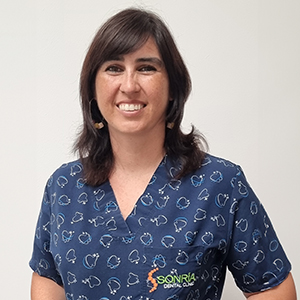
Orthodontist
DDS, PG Adv Ortho, FACE Adv Orth Intl PG
BDS (Madrid), Advanced Program in Orthodontics, New York University; Certificate in Orthodontic Education, New York University; Advanced Postgraduate Course in FACE Philosophy.
GDC No. 182876
Languages Spoken: English, Spanish, German, French


Dr Frühbeck provides orthodontic treatment for adults and children, including fixed appliances and clear aligners.
“I love transforming peoples’ smiles and giving them a healthy functional bite.”
I really enjoy working at Sonria Dental because we have a wonderful international team that work really well together, creating a family like culture that we the team and our patients absolutely love. In addition, the clinic has the latest technologies that allow me to deliver the most state-of-the-art orthodontic care that not only transform peoples’ smiles but also give them a healthy functional bite.
As the resident orthodontist, I provide a wide range of quality orthodontic treatments to adults and children alike, with a special focus in achieving a healthy occlusion while also straightening teeth.
I am specialised in both comprehensive and interceptive orthodontics, with fixed appliances as well as aesthetic alternatives like clear aligners, with a focus on occlusion and TMJ.
I completed my orthodontic training at New York University USA , followed by a 2 year advanced postgraduate course in orthodontics, occlusion and TMJ at the FACE/Roth-Williams Center in Spain. I’m passionate about staying up to date with the latest trends and am continually learning through national and international courses in my areas of interest.
I’m an active member of the British Orthodontic Society and the European Orthodontic Society, a regular lecturer at the Cephtactics PG Certificate Course in Orthodontics and I’ve been a speaker at international meetings.
Outside dentistry, I love sailing and travelling.
I speak English, Spanish, German and French.

If your brace breaks or becomes distorted, contact the practice immediately.
Do You Have any other questions? Call us on 02072241402 or email us on info@sonriadentalclinic.com
Sonria Dental Clinic, 25 Devonshire Place
London W1G 6JD
020 7224 1402 - General Enquiries
07507689112 - Emergencies
Email: info@sonriadentalclinic.com
| Monday to Friday | 8.00 am – 6.00 pm |
| Saturday | 9.00 am – 2.00 pm |
| Sunday | Closed |
For Dental Professionals Only